143 S 5th St - Saint Charles, MO 63301
 (636) 246-1439
 M-F 7:00am - 5:00pm

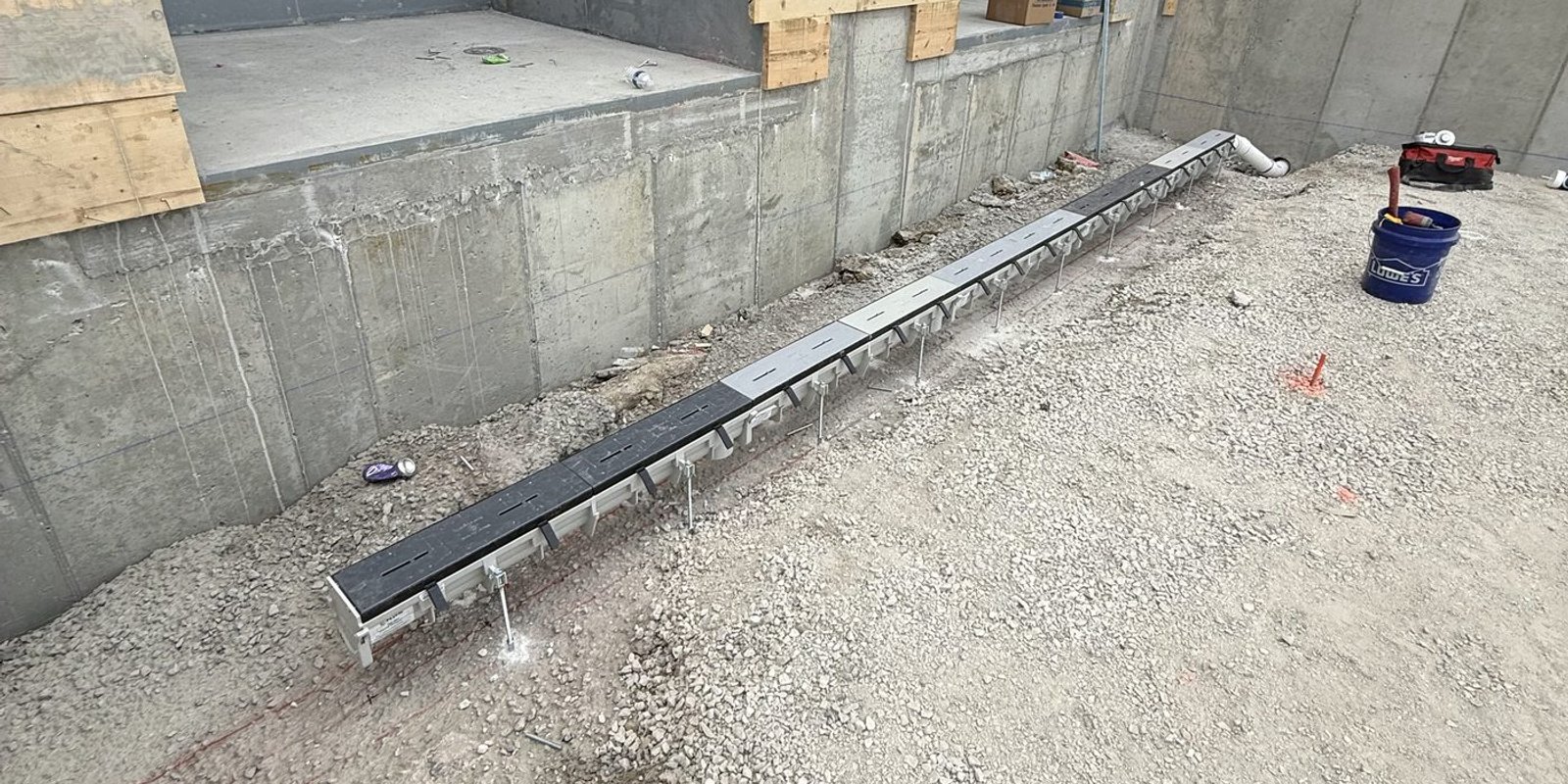
A trench drain is a long, narrow channel set in the ground with a grate on top. It catches water along a line, not at one spot, and sends it into a drain pipe. You see trench drains at loading docks, garage doors, driveways and parking lots, anywhere a lot of water runs across a flat, hard surface.
Some people call it a channel drain or a linear drain. They all mean the same thing. If you need one put in at a business, our commercial plumbing team can set it, tie it into the drain line and make sure it carries water away.
At S&S Plumbing Systems in Saint Charles, we put in drains for homes and businesses across St. Charles County and St. Louis. The photo above is one of our recent jobs: a trench drain at a loading area on a commercial build in Hazelwood.
How does a trench drain work?
A trench drain works by catching water that flows across a surface and moving it down a channel to a pipe. Here is the path the water takes:
- Rain or wash water runs across the concrete toward the drain.
- The water drops through the slots in the grate into the channel below.
- The channel carries the water to an outlet, most often at one end or the bottom.
- The outlet ties into a pipe that runs to the storm or sewer line.
A grate on top keeps feet, tires and big trash out. Below it, the channel does the real work.
What is the difference between a trench drain and a floor drain?
A floor drain catches water at one round spot, so the floor has to slope toward it from every side. A trench drain catches water along its whole length, so the surface only needs to slope one way toward the line.
That is why trench drains are used on wide areas like a driveway or a loading dock. One long drain can catch water across the full width.
| Floor drain | Trench drain | |
|---|---|---|
| Shape | One round or square opening | A long, narrow line |
| How the floor slopes | Toward one spot from all sides | One way, toward the line |
| Common places | Basements, laundry rooms, utility rooms | Driveways, garage doors, loading docks, parking lots |
Where do you need a trench drain?
You need a trench drain where water collects on a hard surface and has nowhere to go. These are the most common spots:
- The bottom of a sloped driveway where water runs toward a garage door.
- In front of a garage or shop door to keep water from running inside.
- Loading docks and truck bays, like our Hazelwood job, where the ground drops down to the dock.
- Parking lots and drive lanes with long, flat runs of concrete.
- Patios and pool decks where water pools near the house.
If you see standing water in the same place after every rain, that spot may need a drain.
How is a trench drain put in?
A trench drain is set in place, leveled and then locked in with concrete. On the Hazelwood job, the channel pieces were set on stakes over the gravel and lined up before any concrete was poured around them. A pipe ties into the far end to carry the water away.
Getting the height and the pitch right matters. If the grate sits too high, water runs along the side of it. If it sits too low, tires hit the edge and it can break.
What do trench drain load ratings mean?
A load rating tells you how much weight the grate and channel can hold. Many trench drains are rated by a standard called EN 1433. It has six classes, A through F. The number after each letter is the test load in kilonewtons (kN). This table is from HAURATON, a trench drain maker:
| Class | Test load | Typical use |
|---|---|---|
| A 15 | 15 kN | Footpaths, bike paths, home driveways |
| B 125 | 125 kN | Private roads, car parking |
| C 250 | 250 kN | Public parking, gas station lots |
| D 400 | 400 kN | Roads, bus stations, commercial areas |
| E 600 | 600 kN | Industrial yards, loading areas |
| F 900 | 900 kN | Airports, ports, container yards |
Pick the class for the heaviest thing that will roll over it. A grate made for foot traffic can crack under a truck or a forklift.
How do you keep a trench drain working?
You keep a trench drain working by keeping the channel clear. Most grates lift out so you can scoop out leaves, dirt and trash, as the maker NDS notes for its channel drains. Check it in the fall after the leaves drop and after big storms.
If water still pools after you clean the channel, the clog may be in the pipe past the outlet. That pipe can be cleared like any other drain line with our drain cleaning service.
FAQ
Is a trench drain the same as a French drain? No. A French drain is a buried trench filled with gravel and a pipe with holes in it. It catches water in the soil. A trench drain is open on top with a grate and catches water running across a hard surface.
Can a trench drain go in an existing driveway or slab? Yes. A plumber cuts a strip out of the concrete, sets the channel, ties it into a drain pipe and pours new concrete around it.
Why is water going around my trench drain instead of into it? Most often the grate is set too high, or the concrete next to it has settled. Leaves or dirt packed into the grate slots can also make water run past it.
Do homes use trench drains, or just businesses? Both. Homes often use them at the bottom of a driveway or by a garage door. Businesses use them at loading docks, drive lanes and parking lots.
Get a trench drain put in
If water pools at your dock, door or driveway, call S&S Plumbing Systems. We will look at where the water goes and tell you straight what it needs. See our commercial plumbing work, or contact us to set up a visit.